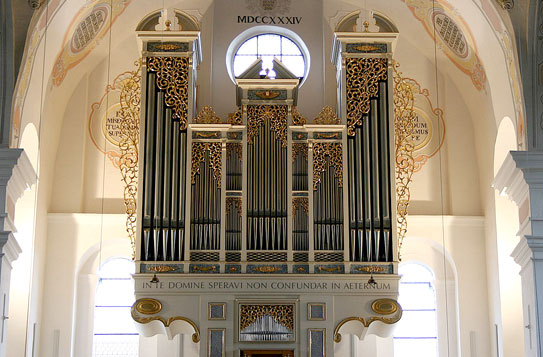
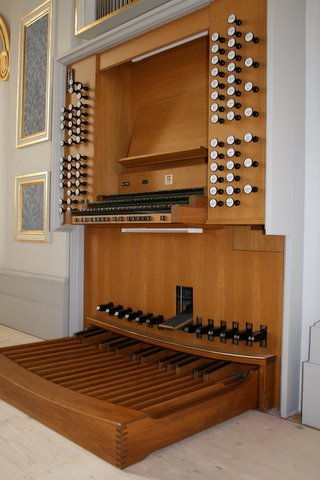
Orgeldisposition
Die Disposition als PDF zum Download (20 KB)Hubert Sandtner Orgelbau , Dillingen, Opus 65
1.
Praestant
16’
2.
Principal
8’
3.
Flauto
8’
4.
Gamba
8’
5.
Octave
4’
6.
Spitzflöte
4’
7.
Quinte
2 2/3’
8.
Superoctave
2’
9.
Cornet V, ab g°
8’
10.
Mixtur VI
1 1/3’
11.
Cymbel III
1/2’
12.
Trompete
8’
1.
Gedeckt
8’
2.
Quintade
8’
3.
Viola
+
8’
4.
Principal
+
4’
5.
Rohrflöte
4’
6.
Sesquialter II
2 2/3’
7.
Octave
2’
8.
Larigot
1 1/3’
9.
Scharff II
2/3’
10.
Dulcian
+
16’
11.
Cromorne
+
8’
Tremulant
1.
Bourdon
8’
2.
Principal
8’
3.
Holzflöte
8’
4.
Salicional
*
8’
5.
Vox coelestis
*
8’
6.
Octave
4’
7.
Querflöte
4’
8.
Nasard
2 2/3’
9.
Flautino
2’
10.
Terz
1 3/5’
11.
Piccolo
+
1’
12.
Mixtur V
2’
13.
Fagott
16’
14.
Trompette harm.
+
8’
15.
Oboe
+
8’
16.
Vox humana
+
8’
Tremulant
1.
Contrabass
8’
2.
Principalbass
*
16’
3.
Subbass
*
16’
4.
Octavbass
*
8’
5
Bourdon
8’
6.
Violoncello
+
8’
7.
Octave
4’
8.
Mixtur V
2 2/3’
9.
Bombarde
+
32’
10.
Posaune
16’
11.
Trompete
8’
12.
Clairon
4’
(Auxiliaire)
8’
Trompeta magna
16’
Trompeta real
8’
Carillon Positiv
g°-g’’
Carillon Pedal
+
G-g’
Cymbelstern
+
Cucculus
+
III-III sub
+
III - P super
+
III-II
III - P
III - I sub
+
II - P
III - I
I - P
II - I
Chamade - III
+
Chamade - II
+
Chamade - I
+
Chamade - P
+
Mechanische Spiel- und elektrische Registertraktur
Spielhilfen: Elektronische Setzeranlage mit 8.000 Kombinationen
Stimmtonhöhe :440 Hz
Stimmtonart: gleichstufig